





Your Cart

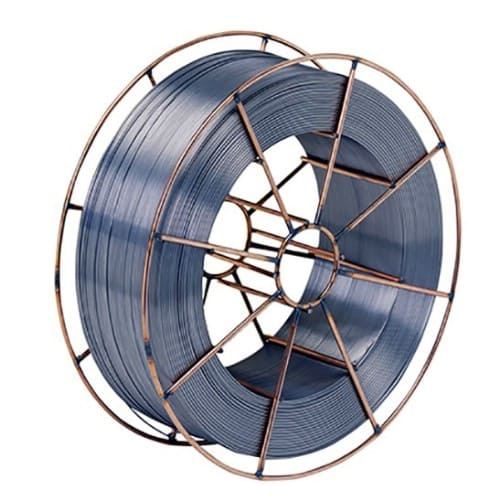
Welding Wire - Rutile Flux-Cored 1.2 mm, Ni1M, 16 kg Spool, ESAB

Rutile flux-cored wire 1.2 mm E81T1-Ni1M 16 kg
Welding Wire - Rutile Flux-Cored 1.2 mm, Ni1M, 16 kg Spool, ESAB
280.36 €
Ex Tax: 224.28 €
  • Stock: In Stock
  • Brand: ESAB
  • Model: RW1503151712
  • Weight: 16.00kg
This product is usually shipped within 1-2 business days after placing the order. The delivery time is typically 3-5 business days depending on the delivery address and the shipping company. The shipping cost is displayed at checkout before the order is submitted.

Quick Facts — RW1503151712 Flux-cored wire

  • Model: RW1503151712
  • Type: Rutile flux-cored wire with 1% nickel
  • Diameter: 1.2 mm
  • Weight: 16 kg
  • Spool type: 77-3
  • Shielding gas: Ar+20%CO2 (M21) or CO2 (C1)

OK Tubrod 15.17 from ESAB is a rutile flux-cored wire in 1.2 mm, alloyed with 1% nickel for good impact toughness down to -40°C. It is supplied on a 16 kg spool of type 77-3.

The wire is intended for carbon-manganese and low-alloy steels in offshore structures, pressure vessels and steel work. It welds in all positions with high productivity and can be combined with ceramic root backing in open V-joints.

What makes Tubrod 15.17 a strong choice for offshore structures and pressure vessels?

The 1% nickel alloying gives the weld metal an impact toughness of 130 J at -40°C, the level required for offshore structures and pressure vessels. Yield strength is 470 MPa and tensile strength 560-650 MPa, with elongation (A5) of 22%.

The wire carries approvals from several classification societies:

  • ABS 3YSA H5 (C1) and (M21)
  • BV SA3YM (M21) and SA3YM HH (C1)
  • DNV-GL IV Y46MS H5 (M21)
  • LR 3YS H5 (C1) and 4Y46S H5 (M21)
  • RINA 4Y40 S H10 (M21)
  • RS 4YMS H5 (M21) and 4YMS H10 (M21)
  • DB 42.039.26 (M21 and C1), VdTÜV 05198 and CE EN 13479

Where Tubrod 15.17 performs best

Tubrod 15.17 performs best in positional welding of carbon-manganese and low-alloy steels in offshore structures, pressure vessels and steel work. It can also be welded against ceramic root backing in open V-joints. The current type is DC+ with shielding gas Ar+20%CO2 (M21) or CO2 (C1).

Technical Specifications

Classification SFA/AWS A5.29E81T1-Ni1M
Classification EN 758T 46 3 1Ni P C 2 H5
Classification SFA/AWS A5.36E81T1-M21A4-Ni1
Classification EN ISO 17632-AT 46 3 1Ni P C1 2 H5 / T 46 4 1Ni P M21 2 H5
Current typeDC+
Chemical compositionC 0.06%, Si 0.3%, Mn 1.1%, Ni 0.9%
Yield strength (ReL)470 MPa
Tensile strength (Rm)560-650 MPa
Elongation (A5)22%
Impact toughness KV130 J at -40°C


Used by: Welders qualified for offshore and pressure vessel work. Welding engineers and welding coordinators. Pipe welders working in open V-joints.

Common in: Offshore. Pressure vessel fabrication. Steel construction. Shipbuilding.

Frequently Asked Questions (FAQ)

Is Tubrod 15.17 flux-cored wire suitable for welding at -40°C?

Yes. Tubrod 15.17 gives an impact toughness of 130 J at the test temperature of -40°C thanks to 1% nickel in the weld metal. The value applies at -40°C specifically, not at lower temperatures.

Which shielding gas and current type are used with Tubrod 15.17?

Tubrod 15.17 is welded with Ar+20%CO2 (M21) or CO2 (C1) and DC+ current. The classification differs between the gases: T 46 4 1Ni P M21 2 H5 with M21 and T 46 3 1Ni P C1 2 H5 with C1.

What sets Tubrod 15.17 apart from other flux-cored wires?

Tubrod 15.17 is a rutile flux-cored wire alloyed with 1% nickel, classified E81T1-Ni1M and T 46 3 1Ni P C 2 H5. The nickel alloying gives 130 J impact toughness at -40°C and 470 MPa yield strength, and the wire can be used against ceramic root backing in open V-joints.

Reviews

Write a review

Note: HTML is not translated!
Rating
Bad Good
Captcha
Last updated: 2026-10-21