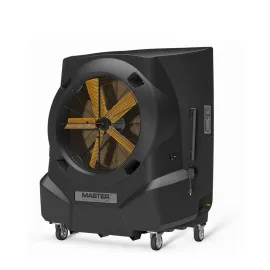






















Portable air coolers and evaporative coolers for industry
Evaporative air cooling is an energy-efficient way to lower the temperature in large, open or well-ventilated premises. Unlike traditional air conditioning systems that use compressors and chemical refrigerants, the technology relies on the natural principle of water evaporation, lowering the incoming air temperature while keeping electricity use to a minimum. Our range includes portable models for everything from single workstations to large industrial halls.
How does an evaporative cooler work?
An evaporative cooler cools the air through water evaporation. An integrated water pump distributes water from the internal tank to cooling pads made of corrugated, glued cellulose, and a powerful axial fan draws warm ambient air through the wet pads. As the air passes the pad, part of the water evaporates and absorbs the heat from the air, giving a continuous stream of cooled, fresh and filtered supply air.
The cooling effect is directly linked to the ambient temperature and humidity — the warmer and drier the air, the more water evaporates and the more the temperature drops. The outgoing air is between 4°C and 12°C lower than the surrounding outdoor air.
What are the benefits of evaporative cooling?
Evaporative cooling gives low energy consumption, clean air and operation without chemicals. The system only needs power for the fan and the small water pump, which considerably lowers running costs compared with compressor-based AC. The process uses only clean water, entirely free of refrigerant gases, and the cellulose pads act as a natural filter that captures dust, pollen and particles before the air is blown out. Several models in the S-series have integrated UV lamps for continuous disinfection of the tank water, reducing the risk of bacteria and fungi.
How are the coolers installed and handled?
The coolers require no fixed installation or exhaust hoses. The machines have robust braked wheels and connect directly to a standard 230 V socket and a standard water hose (½" connection with float valve), or the tank can be filled manually. This makes them easy to move between workstations and place where they are needed most.
Which models are available in the range?
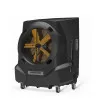
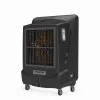
The range covers several sizes for different areas and air requirements, including the Master series, which can be ordered through our webshop. The models span from compact units for single workplaces to powerful biocoolers for large halls.
Depending on how the premises are laid out, it can be advantageous to choose several smaller evaporative coolers rather than a single large one. Multiple units can be placed at different workstations or distributed across the floor, giving more even cooling in premises with several heat sources, partition walls or a long, narrow layout than a single machine would.
| Model | Max airflow (m³/h) | Power (W) | Max cooling area (m²) | Tank volume (litres) | Noise level (dB(A)) |
|---|---|---|---|---|---|
| BC 80 | 8,000 | 330 | 100 | 180 | 62 |
| BC 121 | 12,000 | 500 | 250 | 80 | 67 |
| BC 221S | 22,000 | 800 | 330 | 120 | 67 |
| BC 341S | 30,000 | 1,050 | 400 | 200 | 70 |
Suitable for: production industry, welding and mechanical workshops, car workshops, machine halls, warehouse and logistics centres, aircraft hangars, agriculture and animal housing, and assembly tents for events.
Industries: industry, workshops, warehousing and logistics, agriculture, construction and events.
Frequently asked questions (FAQ)
Does an evaporative cooler increase indoor humidity?
Yes, the humidity in the directly cooled zone rises by roughly 2–5% depending on the temperature. In large, well-ventilated industrial and workshop premises this small increase is not noticeable, since the air is continuously exchanged and vented out.
Do windows or doors need to be open?
Yes, for optimal cooling the premises should be well ventilated. Doors, windows or mechanical exhaust should be kept open so the warm, used air can leave the building at the same rate the machine supplies new, cooled fresh air.
How often does the cooling pad need replacing?
The cellulose cooling pads are chemically treated to resist rot and ensure a long service life. With regular cleaning and maintenance of the air filter, the pads last several seasons before they need replacing.
How much can an evaporative cooler lower the temperature?
The outgoing air is between 4°C and 12°C lower than the surrounding outdoor air. The effect is greatest in warm, dry air, since more water then evaporates.
Which model suits my premises?
The choice depends on the area to be cooled and the air requirement. Our range includes models from about 100 m² cooling area up to 400 m². Depending on the layout, several smaller coolers placed at different workstations can give more even cooling than a single large unit, while the larger biocoolers suit open industrial halls, warehouses and hangars.